BUEA, Cameroon – The protracted land dispute between the communities of Ewonda and Lower Ewonda in Buea Subdivision, Fako Division, South West Region, has taken a new twist following fresh allegations of attempts to reverse administrative decisions linked to disputed land certificates.
Dr. David Makongo has called on the Minister of Territorial Administration (MINAT) to order the immediate suspension of all activities affecting the disputed Ewonda ancestral lands pending an independent investigation into the administrative and documentary processes surrounding the controversy.
In a public appeal on his facebook page, Makongo urged the government to halt all land-related activities, including construction works, land sales, transfers, and further administrative processing, until the relevant authorities establish the facts and make a final decision public.
His intervention comes against the backdrop of a land dispute that has continued to generate concern among members of the Ewonda community, particularly following the reported cancellation of land certificates associated with Lower Ewonda.
Fresh allegations emerge over cancelled Lower Ewonda land certificates
According to an earlier investigation published by The Guardian Post, in its Wednesday, September 30, 2026 edition, No. 3925, under the headline “As a Land Crisis Deepens: Armed Gangs, Attacks, No Enforcement of Court Orders Spark Fear in Community,” the dispute involves approximately 80 to 85 hectares of land claimed by members of the Ewonda community.
The newspaper’s report, written by Timothy Shing, highlighted allegations of continued encroachment, destruction of ancestral farmlands, land sales, and the presence of armed individuals despite administrative decisions and court interventions relating to the disputed properties.
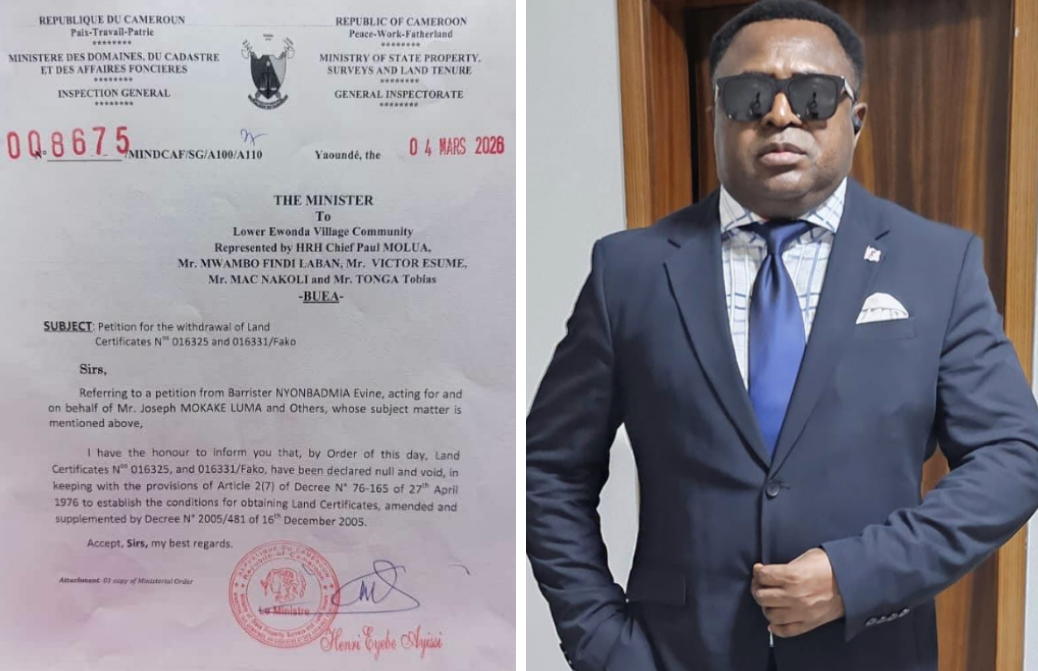
The controversy reportedly intensified after land certificates associated with Lower Ewonda were cancelled by the Ministry of State Property, Surveys and Land Tenure (MINDCAF) in late 2025 and March 2026, reportedly on grounds of fraud and administrative irregularities.
However, in his latest intervention, Dr. Makongo alleges that following the cancellations, some individuals who had sold portions of the disputed land came under pressure to refund buyers. He further claims to have received reports alleging that certain officials may have used their administrative positions to pursue the reinstatement of Lower Ewonda’s administrative recognition and a prefectural order concerning its chief.
According to Makongo, such alleged administrative actions could potentially create conditions for the reinstatement of the previously cancelled land certificates. These allegations have not been independently established. The authorities concerned are yet to publicly clarify the specific administrative actions, if any, that may have been taken.
Dr. Makongo demands investigation into National Cartographic Institute records
A central aspect of Makongo’s appeal concerns the administrative recognition and cartographic documentation of Lower Ewonda.
He is specifically calling for an investigation into the circumstances under which Lower Ewonda was reportedly entered into the records of the National Cartographic Institute in Yaoundé.
Among the questions he wants the government to address are:
- Who initially requested the inclusion of Lower Ewonda in the National Cartographic Institute’s records?
- Which officials approved the entry?
- When was the approval granted?
- What documentary evidence and administrative procedures supported the decision?
- Were the records consistent with the original documents and decisions that led to the cancellation of the disputed land certificates?
Makongo is urging the government to preserve all relevant maps, correspondence, registers, administrative orders and land registration files to prevent the loss or alteration of potentially important evidence.
He also insists that the affected Ewonda families must be given a formal opportunity to present their claims and supporting documents during the investigation.
Calls for protection of Ewonda ancestral lands
The dispute has raised broader questions about the protection of ancestral land rights, the integrity of land administration, and the enforcement of administrative and judicial decisions in Cameroon.
For communities whose livelihoods, cultural identity and economic survival depend on ancestral lands, unresolved land disputes can have serious consequences.
In the case of Ewonda, the allegations reported by The Guardian Post point to a situation in which residents have expressed fear over continued encroachment and the alleged destruction and sale of farmland despite previous legal and administrative interventions.
The community’s reported recourse to self-protection measures also raises concerns about the potential escalation of tensions and the risks of violence if the dispute is not addressed through lawful and credible institutional mechanisms.
Dr. Makongo maintains that if an independent investigation establishes that the affected families were unlawfully dispossessed, the government should take the necessary steps to restore the ancestral lands to their rightful holders.
Appeal to the Minister of Territorial Administration
In directly addressing the Minister of Territorial Administration, Makongo described the protection of Indigenous communities and their ancestral lands as an important test of public trust in government institutions.
He argued that allowing further land transactions, construction activities and boundary demarcations while the dispute remains unresolved could make it increasingly difficult to remedy any eventual finding of wrongful dispossession.
He therefore called for coordinated action involving MINAT, MINDCAF and the competent local administrative authorities.
His proposed immediate measures include:
- An immediate suspension of all activities affecting the disputed Ewonda ancestral lands.
- An independent investigation into the administrative recognition and cartographic records of Lower Ewonda.
- The preservation of all relevant land documents, maps, correspondence and administrative orders.
- A review of the decisions and documentary evidence behind the cancellation of the disputed land certificates.
- A formal hearing for affected Ewonda families and other relevant stakeholders.
- Publication of the investigation’s findings and the reasons supporting the government’s final decision.
- Restoration of the affected ancestral lands if unlawful dispossession is established.
A test for land governance and the rule of law in Cameroon
The Ewonda land controversy goes beyond a disagreement over boundaries or ownership. It raises fundamental questions about the credibility of land administration, respect for administrative decisions, access to justice and the protection of community land rights.
Where land certificates are cancelled through official procedures, the public deserves clarity on whether subsequent administrative actions comply with the law and whether any attempt is being made to reverse those decisions outside established legal processes.
Equally, allegations of fraudulent land registration, unlawful encroachment and the involvement of public officials must be subjected to impartial investigation rather than treated as established facts without verification.
The government now faces an opportunity to demonstrate that land administration in Cameroon is guided by transparency, accountability and respect for the law.
For the Ewonda community, the immediate concern is straightforward: preventing further transactions or developments on the disputed land while establishing the legitimate ownership claims through credible legal and administrative processes.
As Dr. Makongo’s appeal puts it, the priority should be to suspend activities, preserve the evidence, investigate the paper trail and publish the findings.
The central question remains: Who authorised the disputed administrative and cartographic decisions, and what documentary evidence supports them?
The answers could prove critical to resolving the Ewonda ancestral land dispute and restoring confidence in the institutions responsible for protecting land rights in Cameroon.
ABOUT THE REPORT: This article, by Berinyuy Cajetan is based on the public appeal attributed to Dr. David Makongo on his facebook page and information contained in The Guardian Post, Edition No. 3925, published on September 30, 2026. Allegations concerning administrative interference and attempts to reinstate cancelled land certificates require independent verification and responses from the authorities and individuals concerned.