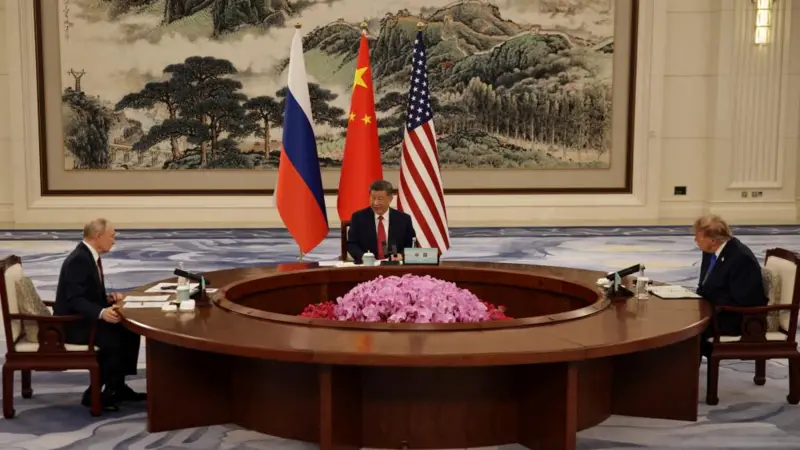
China, Russia and US Leaders Issue Joint Peace Declaration, Pledge Energy Cooperation and Nuclear Risk Reduction
SHENZHEN, China, November 19, 2026 – In what could become a significant diplomatic development in international relations, the leaders of China, Russia and the United States have issued a joint declaration committing their countries to strengthening international security, promoting energy cooperation, supporting reforms within the United Nations and engaging in dialogue to reduce nuclear risks.
The declaration followed a trilateral summit held in Shenzhen, China, on Thursday, November 19, 2026, bringing together Chinese President Xi Jinping, Russian President Vladimir Putin and United States President Donald J. Trump.
According to the full text released by China’s state news agency, Xinhua, the three leaders exchanged views on the prevailing international situation and reaffirmed their commitment to maintaining strategic stability and international security.
The meeting is particularly significant given the geopolitical tensions, competing strategic interests and security challenges that have characterised relations among the three global powers in recent years.
Three Global Powers Commit to Strengthening International Security
In the joint declaration, the leaders recognised their special responsibilities as permanent members of the United Nations Security Council and expressed their commitment to reforming the international organisation.
The declaration states that China, Russia and the United States will work towards making the United Nations more effective in responding to global challenges and better aligned with its fundamental mission of maintaining international peace and security.
The commitment places renewed attention on the role of the United Nations in addressing international conflicts, preventing wars and promoting cooperation among nations.
However, the declaration does not provide specific details about the proposed reforms or the mechanisms through which the three countries intend to implement them.
The question of UN reform has remained a major subject of international debate, particularly concerning the effectiveness of the Security Council, representation of developing countries and the ability of the international system to respond to contemporary security threats.
China, Russia and US Plan to Increase Refined Petroleum Production and Supply
One of the major economic issues highlighted in the declaration is global energy security.
The three countries announced plans to increase the production and supply of refined petroleum products for the benefit of countries around the world.
The leaders also reaffirmed the importance of maintaining stable energy flows.
This commitment could have significant implications for international energy markets, considering the strategic importance of China, Russia and the United States in global energy production, consumption, trade and supply chains.
Stable petroleum supplies are essential to transportation, industrial production, electricity generation and economic activities across different regions.
For developing economies, particularly countries that depend heavily on imported petroleum products, disruptions in international energy markets can contribute to rising transportation costs, inflation and increased pressure on household incomes.
If translated into practical cooperation, the proposed expansion of refined petroleum production and supply could contribute to strengthening global energy availability.
Nevertheless, the declaration does not specify production targets, implementation timelines, pricing arrangements or the countries expected to benefit from the proposed initiative.
Leaders Reaffirm That Nuclear War Must Never Be Fought
Another significant component of the declaration concerns nuclear weapons and the prevention of nuclear conflict.
Xi Jinping, Vladimir Putin and Donald Trump reaffirmed the principle that a nuclear war cannot be won and must never be fought.
The three countries also committed to conducting dialogue on reducing nuclear risks and preventing the proliferation of nuclear weapons.
The statement carries particular international significance at a time when nuclear capabilities remain central to the military strategies and national security calculations of several powerful states.
China, Russia and the United States possess some of the world’s most significant nuclear arsenals. Their decisions concerning nuclear weapons, military cooperation and strategic stability therefore have consequences that extend far beyond their national borders.
Dialogue between the three powers could provide an opportunity to address nuclear escalation, improve communication during periods of heightened international tension and strengthen measures aimed at preventing the spread of nuclear weapons.
However, the declaration does not announce a new nuclear disarmament agreement, establish specific limits on nuclear arsenals or provide a timetable for negotiations.
Its immediate commitment is centred on dialogue, risk reduction and preventing nuclear proliferation.
International Criminal Court and Immunity of State Officials
The declaration also addresses the controversial question of state immunity and the jurisdiction of international judicial institutions.
According to the statement, the three heads of state recognised the importance of the principle of state consent and respect for the immunities of state officials.
They further agreed that the International Criminal Court (ICC) and other similar institutions must not abuse their jurisdiction.
This position raises important questions about the relationship between national sovereignty, international criminal justice and accountability for serious violations of international law.
The International Criminal Court, established under the Rome Statute, is mandated to investigate and prosecute individuals accused of genocide, crimes against humanity, war crimes and the crime of aggression, subject to its jurisdictional framework.
The court’s relationship with states that are not parties to the Rome Statute has remained a subject of international legal and political debate.
While the three leaders emphasised respect for state consent and official immunities, the declaration does not specify particular cases, judicial proceedings or proposed changes to the ICC’s legal framework.
The issue is likely to attract further attention from international legal experts, human rights organisations and governments concerned about the balance between state sovereignty and international accountability.
What the Shenzhen Declaration Could Mean for the International Community
The joint declaration represents an important diplomatic statement by three countries with considerable influence over global security, economic relations, energy markets and international governance.
Its four principal areas of cooperation are particularly noteworthy:
- United Nations reform: Strengthening the UN’s capacity to respond to global challenges and maintain international peace and security.
- Energy security: Increasing the production and supply of refined petroleum products while promoting stable energy flows.
- International justice: Emphasising state sovereignty, official immunities and the proper exercise of jurisdiction by international judicial institutions.
- Nuclear security: Promoting dialogue to reduce nuclear risks and prevent the proliferation of nuclear weapons.
For countries across Africa, Asia, Europe and Latin America, developments in these areas could have important economic, diplomatic and security implications.
African economies, for example, remain exposed to fluctuations in international petroleum prices, global supply disruptions and geopolitical tensions involving major energy-producing and consuming countries.
Greater stability in international energy markets could therefore be beneficial, particularly if the proposed cooperation translates into more reliable supplies and improved affordability.
Similarly, stronger commitments to nuclear risk reduction and international peace could contribute to a more predictable global security environment.
From Diplomatic Commitments to Practical Action
Despite the significance of the declaration, its long-term impact will depend largely on implementation.
Statements supporting international peace, energy security and nuclear risk reduction are important, but translating them into measurable outcomes requires sustained diplomatic engagement, institutional cooperation and concrete policy measures.
The absence of specific implementation timelines, production targets and detailed mechanisms means that the declaration should be understood primarily as a political and diplomatic commitment rather than a fully developed agreement establishing binding operational obligations.
The Shenzhen summit nevertheless sends an important message about the need for dialogue among major global powers, particularly at a time when international cooperation remains essential to addressing shared challenges.
Whether the commitments made by Xi Jinping, Vladimir Putin and Donald Trump will produce lasting improvements in international security, global energy stability and nuclear risk reduction remains to be seen.
For now, the joint declaration places renewed attention on the responsibilities of the world’s major powers in shaping a more stable international order.
Source: Xinhua News Agency, China-Russia-U.S. Heads of State Declaration toward Peace, November 19, 2026.
Published by: BeriComsEmpire