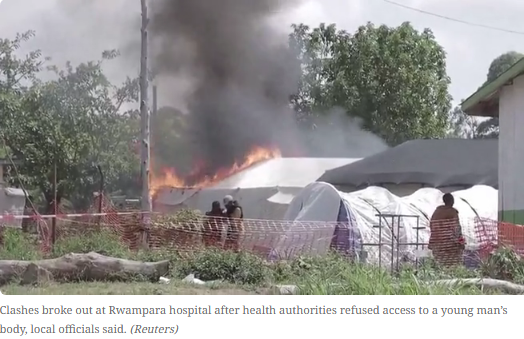
BUNIA, Democratic Republic of the Congo. Tensions have reached a boiling point in the eastern Democratic Republic of the Congo (DRC) after a group of angry residents stormed and set fire to an Ebola treatment facility in the town of Rwampara, Ituri province. The violent outburst highlights the volatile intersection of strict public health protocols and local cultural customs in a region already ravaged by conflict and displacement.
The unrest erupted on Thursday the 21 of May 2026 when health authorities at Rwampara Hospital refused to release the body of a young man who had died from the virus. According to Luc Mambele, vice president of the Congolese political party A2RC, relatives and friends of the deceased attempted to take the body “by force.” When their access was blocked, the confrontation escalated rapidly.
Witnesses reported that a crowd of local youths began hurling projectiles at the facility, sparking a massive blaze. The Associated Press (AP) reported that an on-the-ground journalist witnessed people breaking into the center, torching items inside, and setting fire to what appeared to be the body of at least one suspected Ebola victim being stored there.
“The police intervened to try to calm the situation, but unfortunately they were unsuccessful,” Alexis Burata, a local student who witnessed the chaos, told The AP. “The young people ended up setting fire to the center.”
The medical humanitarian organization Alliance for International Medical Action (ALIMA), which operates the site, confirmed that two hospital tents were burned down. Video footage obtained by Reuters and broadcast by CNN showed a large blaze engulfing the structures, leaving behind scorched metal frames over blackened hospital beds.
At the time of the attack, six patients were undergoing treatment inside the tents. ALIMA stated they were safely evacuated and are now being cared for in the main hospital building. Aid workers were seen fleeing the area in vehicles as warning shots were fired by police to disperse the crowd.
Hama Amadou, ALIMA’s field coordinator in Rwampara, later confirmed that calm had been restored and aid teams had resumed their vital operations. However, the organization strictly warned against the spread of misinformation on social media, which they noted is fueling fear and deep-seated mistrust toward medical facilities.
Cultural Friction and Growing Suspicion
The violence underscores a devastating disconnect between necessary medical safety and sacred community traditions. Because the bodies of Ebola victims remain highly contagious after death, both international health agencies and Congolese officials mandate that burials be handled exclusively by specialized teams in protective gear.
Traditional funeral practices in the region often involve washing, touching, and kissing the body, alongside large communal gatherings—actions that health experts warn act as super-spreader events for the virus.
“His family, friends, and other young people wanted to take his body home for a funeral even though the instructions from the authorities during this Ebola virus outbreak are clear,” Deputy Senior Commissioner Jean Claude Mukendi, head of public security in Ituri province, told The AP. “All bodies must be buried according to the regulations.”
However, as reported by Al Jazeera, these stringent measures are frequently perceived by grieving families as harsh and inhumane. Being denied the right to perform final rites has fostered suspicion that health workers are hiding the truth about what happens inside the isolation walls.
The attack comes at a perilous time for the DRC. The government confirmed that at least 160 deaths are currently linked to the disease, with 13 new confirmed cases and 78 suspected cases documented in Ituri province alone on Thursday.
Compounding the panic is the nature of the virus itself: laboratory tests have identified it as the Bundibugyo strain, a rare variant for which there is currently no specific treatment or approved vaccine.
Furthermore, the geographic footprint of the virus is expanding. The M23 rebel group reported a death near the city of Bukavu, marking the first confirmed case in South Kivu Province—roughly 500 kilometers (310 miles) south of the outbreak’s epicenter in Ituri. The virus reportedly spread undetected for weeks because health authorities initially tested for a different, more common Ebola strain.
The World Health Organization (WHO) has already declared the outbreak a public health emergency of international concern. “We are still in the phase where we are intensifying the investigation, searching for cases,” said Jean Kaseya, Director-General of the Africa Centers for Disease Control and Prevention, noting he expects numbers to rise as surveillance tightens.
The crisis is heavily aggravated by severe international aid cuts and relentless armed conflict. Just days prior to the hospital attack, an assault by militants linked to the Islamic State group killed at least 17 people in a nearby village. There are currently more than 920,000 internally displaced people in Ituri province, creating a breeding ground for rapid transmission.
The outbreak is already causing international ripples:
- The African Union and India announced the postponement of the upcoming India-Africa Forum Summit in New Delhi.
- The DRC national soccer team canceled its World Cup preparation training camp in the capital of Kinshasa.
- The U.S. Government implemented strict travel restrictions, routing all travelers who have visited the DRC, Uganda, or South Sudan within the last 21 days through Washington Dulles International Airport for mandatory health screenings.
As medical supplies and personnel run dangerously low, international teams emphasize that medical science alone cannot win this battle. “The priority now is to act quickly and work closely with communities,” warned Ariel Kestens of the International Federation of Red Cross and Red Crescent Societies, “as the coming days are critical.”