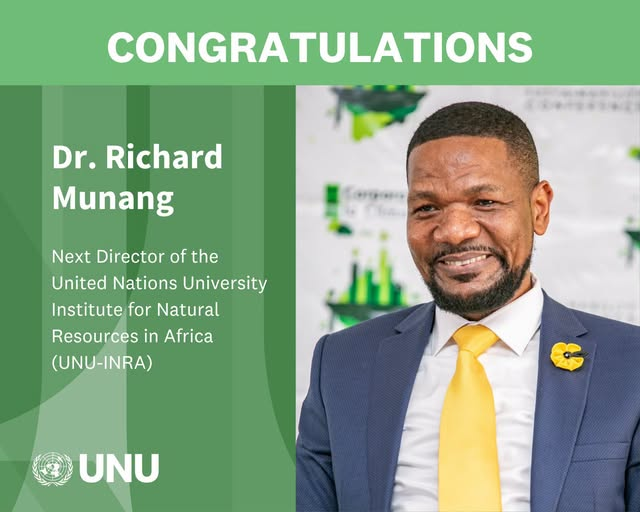
In a significant milestone for Cameroon and the African scientific community, Dr. Richard Munang, a globally respected sustainability expert, has been appointed as the next Director of the United Nations University Institute for Natural Resources in Africa (UNU-INRA), headquartered in Accra, Ghana.
The appointment was announced by the United Nations University (UNU), with Dr. Munang set to officially assume office on 14 September 2026. His appointment recognizes nearly two decades of distinguished leadership in climate change adaptation, natural resource governance, environmental monitoring, and sustainable development across Africa and the Global South.
A Cameroonian national, Dr. Munang has established himself as one of Africa’s leading voices on sustainability, climate resilience, environmental governance, and systems transformation.
Throughout his career within the United Nations system, he has worked to bridge the gap between scientific research and practical policy implementation, helping governments develop innovative solutions to some of the continent’s most pressing environmental challenges.
His new role at UNU-INRA places him at the forefront of advancing African-led research and evidence-based policymaking on natural resource management and sustainable development.
Dr. Munang currently serves as Head of the Global Programme on Crimes that Affect the Environment at the United Nations Office on Drugs and Crime (UNODC).
In this position, he leads global efforts to combat:
- Illegal mining
- Illegal logging
- Illegal fishing
- Wildlife trafficking
- Hazardous waste crimes
His work has strengthened international cooperation by integrating environmental intelligence with law enforcement, supporting investigations, prosecutions, and policy reforms aimed at protecting natural resources.
Before joining UNODC, Dr. Munang held several senior leadership positions at the United Nations Environment Programme (UNEP).
These include:
- Head of the Global Environment Monitoring Systems;
- Deputy Regional Director of UNEP’s Regional Office for Africa;
- Africa Regional Climate Change Coordinator.
Across these roles, he helped strengthen environmental monitoring systems, climate adaptation programmes, clean energy initiatives, innovative financing mechanisms, and food security strategies throughout Africa.
Dr. Munang has been instrumental in designing and implementing several groundbreaking initiatives that have shaped Africa’s climate and development agenda.
Among his notable contributions are:
- Leading the development of the first Africa Adaptation Gap Report, which elevated climate adaptation as a continental priority alongside emissions mitigation.
- Developing climate entrepreneurship curricula adopted by African universities.
- Promoting innovative volunteerism programmes that have equipped millions of African youths with practical skills for green enterprise and climate resilience.
These initiatives have contributed significantly to building Africa’s capacity to respond to climate change while creating sustainable economic opportunities.
Beyond his United Nations responsibilities, Dr. Munang serves as an Adjunct Research Professor at Western University in Canada, where he teaches and supervises research on:
- Climate resilience
- Planetary health
- Environmental risk
- Data-driven environmental decision-making
He has authored more than 100 scholarly publications, including peer-reviewed journal articles, books, and book chapters.
His outstanding contributions have earned him several international honours, including:
- Top 50 Global Thought Leaders in Sustainability
- Top 100 Africa and Middle East Sustainability Voices
- Your Nottingham Alumni Award
- UNEP Baobab Award for Programme Innovation
- International Environmental Roundtable Africa Environmental Hero Award
Strong Academic Credentials
Dr. Munang holds:
- A PhD in Environmental Change and Policy from the University of Nottingham (United Kingdom).
- An Executive Certificate in Climate Change and Energy Policymaking from the Harvard Kennedy School, Harvard University (United States).
His combination of academic excellence and practical leadership has made him one of Africa’s foremost experts in sustainability and environmental governance.
UNU Welcomes New Leadership
Welcoming the appointment, United Nations University Rector and UN Under-Secretary-General Professor Tshilidzi Marwala described Dr. Munang as an exceptional leader capable of advancing the University’s mission across Africa.
He praised Dr. Munang’s unique ability to combine scholarship, programme implementation, and policy expertise while translating scientific knowledge into practical solutions that support sustainable development.
According to Prof. Marwala, Dr. Munang’s leadership will strengthen UNU’s partnerships and research impact throughout Africa and the Global South.
Dr. Munang’s Vision for Africa
Speaking after his appointment, Dr. Munang expressed gratitude for the opportunity to lead UNU-INRA.
“I am truly honoured by the opportunity to lead UNU-INRA and to build on the remarkable legacy my predecessors have established. Africa’s natural resources are the foundation of the continent’s future, and the need for rigorous, African-led science that is connected to policy and action has never been greater.”
He added that he is committed to making the Institute a trusted source of evidence that enables African countries to transform their natural wealth into sustainable, inclusive, and resilient development.
The United Nations University Institute for Natural Resources in Africa (UNU-INRA) is based in Accra, Ghana, and serves as the United Nations’ principal research institute dedicated to natural resource governance in Africa.
The Institute works with governments, academic institutions, regional organizations, and development partners to promote evidence-based policies that support sustainable resource management, economic transformation, and environmental resilience across the continent.
Dr. Richard Munang’s appointment represents another major achievement for Cameroon on the international stage. It highlights the growing influence of Cameroonian professionals within the United Nations system and reinforces Africa’s increasing leadership in global discussions on climate change, sustainability, and natural resource governance.
As Africa faces mounting environmental, climate, and development challenges, his leadership is expected to play a pivotal role in advancing science-driven solutions that benefit communities across the continent