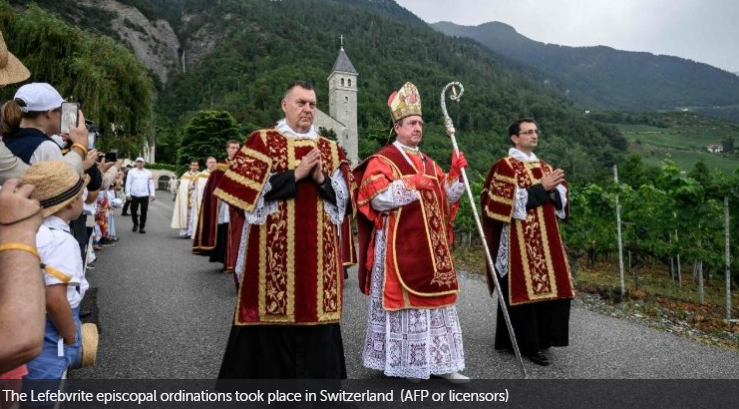
The Vatican has formally declared six bishops of the Priestly Fraternity of Saint Pius X (SSPX) excommunicated after the Society proceeded with the episcopal consecration of four new bishops without papal approval, marking one of the most significant developments in the Catholic Church’s relationship with the traditionalist movement in decades.
In a decree issued on 2 July 2026, Cardinal Víctor Manuel Fernández, Prefect of the Dicastery for the Doctrine of the Faith, stated that the episcopal consecrations carried out on 1 July in Écône, Switzerland, constituted “an act of a schismatic nature.” The decree was signed following the consecration ceremony conducted despite repeated objections from Pope Leo XIV.
Six Bishops Excommunicated
According to the decree, the principal consecrator, Bishop Alfonso de Galarreta, co-consecrator Bishop Bernard Fellay, and the four newly consecrated bishops—Pascal Schreiber, Michael Goldade, Michel Poinsinet de Sivry, and Marc Hanappier—have automatically incurred (latae sententiae) excommunication reserved to the Apostolic See.
The Vatican stated that the bishops violated canon law by performing episcopal consecrations without a pontifical mandate and against the explicit will of the Roman Pontiff.
Vatican Declares SSPX in Schism
Alongside the decree, the Dicastery for the Doctrine of the Faith released an explanatory note stating that the unauthorized consecrations constitute the canonical crime (delict) of schism.
The Vatican emphasized that decades of dialogue, beginning under Pope Paul VI and continuing through successive pontificates, had failed to restore the Society to full communion with the Catholic Church.
The note concludes that:
- Clergy belonging to the SSPX are considered to be in schism and are subject to excommunication under Canon 1364 §1.
- Lay faithful who formally adhere to the SSPX and knowingly embrace its schismatic position are also considered schismatics and may incur excommunication under the conditions outlined in the 1996 explanatory note of the Pontifical Council for Legislative Texts.
- Sacraments administered by SSPX clergy are illicit, while confessions heard by SSPX priests and marriages witnessed by them are declared invalid.
The Vatican nevertheless stressed that Catholics wishing to return to full communion with the Church would be welcomed with “sincere affection and lively solicitude.”
Clarification on Lay Members
Following widespread media reports, Vatican officials clarified that not every person who attends an SSPX chapel is automatically excommunicated.
Rather, the sanction applies to those who formally adhere to the Society’s doctrinal positions and habitually participate in its religious life while rejecting communion with the Roman Pontiff.
The clarification was intended to distinguish committed members of the movement from occasional attendees.
Background: The Society of Saint Pius X
The SSPX was founded in 1970 by Archbishop Marcel Lefebvre in opposition to reforms introduced by the Second Vatican Council (1962–1965). The Society rejects several post-conciliar reforms, particularly changes to the Catholic liturgy and aspects of the Church’s engagement with the modern world.
Among its distinctive practices are:
- Celebration of the Traditional Latin Mass.
- Priests facing the altar (ad orientem) during Mass.
- Distribution of Holy Communion directly on the tongue to kneeling communicants.
- Greater emphasis on traditional Catholic teachings concerning morality and family life.
- Opposition to ecumenical initiatives and interfaith dialogue introduced after Vatican II.
The Society is estimated to have approximately 600,000 adherents worldwide, with significant communities in France, the United States, and several other countries.
A Divided Response
Many SSPX members insist that they remain faithful to authentic Catholic tradition and believe it is the Vatican—not the Society—that has departed from historic Catholic teaching.
Speaking to the BBC, one SSPX member from Jersey said the excommunication would not alter her commitment to the movement, arguing that the Society preserves what she considers the true Catholic faith.
Others within the Catholic Church, however, view the Vatican’s decision as a necessary response to a direct challenge to papal authority and ecclesial unity.
Historical Echoes
The latest decree recalls the events of 1988, when Archbishop Marcel Lefebvre consecrated four bishops without papal approval, resulting in excommunications under Pope John Paul II. Although those excommunications were later lifted as part of reconciliation efforts under Pope Benedict XVI, the SSPX never achieved full canonical regularization within the Catholic Church.
This week’s episcopal consecrations have effectively reversed years of dialogue and reconciliation efforts.
What Excommunication Means
Excommunication is the Church’s most severe ecclesiastical penalty. It does not erase baptism but places an individual outside full communion with the Catholic Church.
Those under excommunication are generally prohibited from receiving the sacraments, exercising ecclesiastical ministry, or participating fully in the sacramental life of the Church.
The Vatican has urged all Catholics to remain in communion with Pope Leo XIV and bishops united with him and to refrain from participating in liturgical celebrations or activities organized by the SSPX.
Looking Ahead
The Vatican’s decision represents a significant turning point in its relationship with the Society of Saint Pius X. While the Holy See has reaffirmed its willingness to welcome those who seek reconciliation, the decree makes clear that continued adherence to the Society’s schismatic position carries serious canonical consequences.
For SSPX members around the world, the decision presents a profound choice: remain with a movement now officially declared to be in schism or seek reconciliation with the Roman Catholic Church.