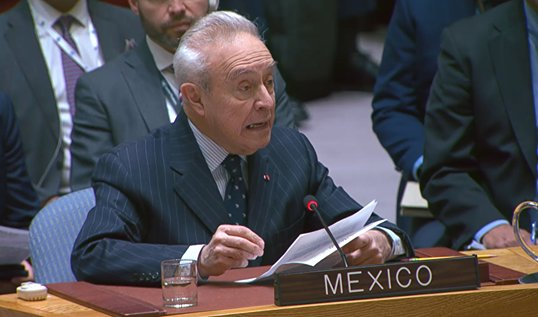
As reported by the United Nations, In a recent intervention during the UN Security Council Meeting on 5 January 2026, Mexico’s representative delivered a powerful reminder of the principles that underpin international law and collective security. His words cut to the heart of today’s geopolitical tensions: “The United States’ action must not be permitted, calling it a violation of the UN Charter and a threat to multilateralism.”
This statement underscores a growing concern among member states that unilateral measures, particularly those involving regime change or extraterritorial enforcement, risk undermining the very foundations of the international system.
The UN Charter enshrines the sovereignty of nations and the right of peoples to determine their own destinies. Mexico’s representative stressed that the Security Council has an “obligation to act decisively and without double standards.” This is not just a procedural demand, it is a moral one.
When powerful states bypass multilateral frameworks, they erode trust in international institutions and weaken the legitimacy of collective decision-making. Sovereignty, in this context, is not a shield for impunity but a safeguard against domination.
Mexico’s warning against regime change by external actors is rooted in historical experience. Time and again, interventions justified as “liberation” or “stabilization” have left societies fractured, economies devastated, and human rights compromised.
As he noted, such actions have “historically only exacerbated conflicts and weakened societies.” From Latin America to the Middle East, the record is clear: externally imposed solutions rarely produce lasting peace.
Multilateralism is not simply a diplomatic buzzword, it is the architecture that prevents chaos. By insisting that disputes be resolved through collective mechanisms, Mexico’s representative defended the principle that no single nation should dictate the fate of another.
In a world facing overlapping crises—climate change, conflict, inequality—the erosion of multilateralism would be catastrophic. The Council’s credibility depends on its ability to act without bias, applying the same standards to all states, regardless of power.