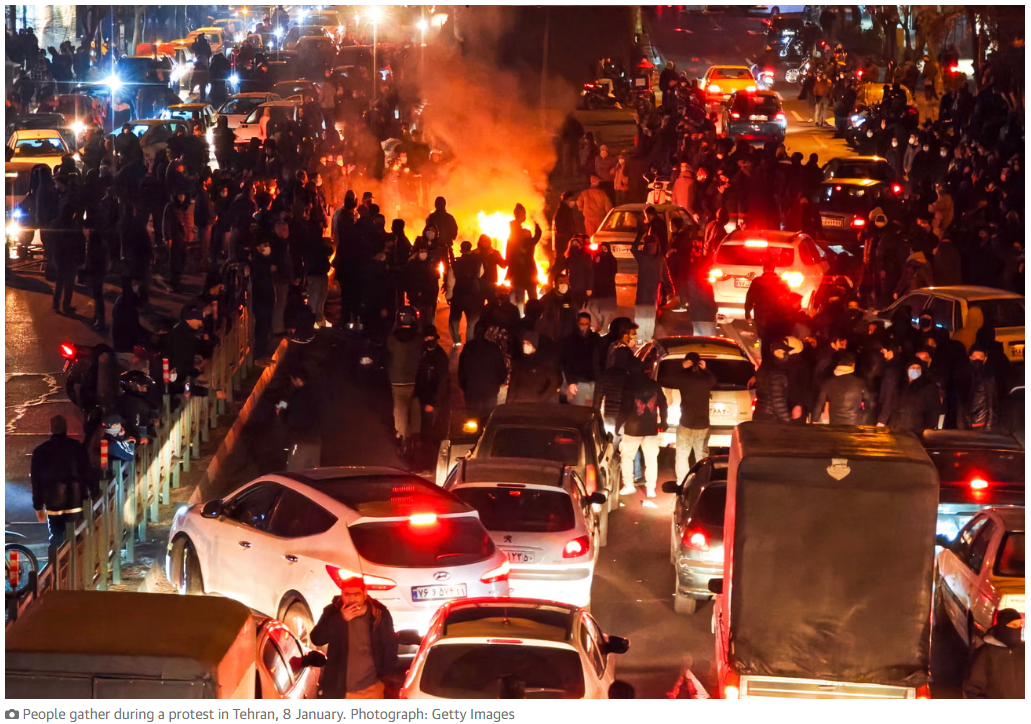
Iran is once again at the centre of international attention as nationwide protests, triggered by economic collapse, have escalated into one of the most severe political crises the Islamic Republic has faced in decades. According to reports by Reuters, BBC, and Al Jazeera, more than 2,500 people have been killed in just over two weeks of unrest, with thousands more injured or detained. The scale of the crackdown, the sharp rhetoric from the United States, and mounting accusations of foreign interference by the Iran government have transformed what began as economic demonstrations into a volatile confrontation with significant regional and global implications.
The protests began on December 28, 2025, in Tehran’s Grand Bazaar after Iran’s currency, the rial, plunged to record lows. Once trading at roughly 70,000 to the U.S. dollar a decade ago, the rial has now depreciated to more than 1.4 million to the dollar. This dramatic decline has fueled runaway inflation, with food prices reportedly 72 percent higher than the previous year. Shopkeepers, workers, and ordinary citizens took to the streets in frustration over unaffordable living costs, unpaid wages, and vanishing purchasing power.
What began as economic protests rapidly evolved into broader political dissent. Demonstrations spread to more than 180 cities across all 31 provinces, with protesters calling not only for economic relief but also for systemic political change. The unrest now represents the most serious domestic challenge to Iran’s clerical establishment since the 1979 Islamic Revolution.
Human rights organizations paint a grim picture of the state’s response. Reuters reports that at least 2,571 people have been killed, including protesters, government-affiliated personnel, children, and uninvolved civilians. Other monitoring groups suggest the real figures may be far higher, particularly given internet blackouts and restrictions on independent reporting.
Iranian authorities, while acknowledging large-scale casualties, attribute the violence to “terrorist groups” allegedly guided by foreign intelligence services as reported by Al Jazeera. Iranian State television has claimed that armed factions, not security forces, are responsible for much of the bloodshed. Yet multiple international observers and rights groups have described the crackdown as “unbearable and inhumane,” citing live ammunition, mass arrests, and expedited trials.
The Chief Justice of Iran has emphasized swift punishment for those accused of violent acts during the protests, reinforcing concerns that due process and judicial fairness are being sidelined in the name of restoring order.
U.S. President Donald Trump has taken a hardline public stance, openly encouraging Iranians to continue protesting while warning Tehran that “help is on the way.” He has cancelled all meetings with Iranian officials and stated that military action remains “among the options” under consideration. In parallel, Washington has announced 25 percent import tariffs on any country trading with Iran, further tightening economic pressure.
Trump’s rhetoric has drawn strong reactions from Tehran, which accuses the United States and Israel of seeking regime change and encouraging political destabilization. Iran’s UN ambassador has formally complained to the Security Council, warning that external incitement to unrest violates national sovereignty.
Behind the scenes, diplomatic activity has intensified. Iranian officials have engaged counterparts in Qatar, Turkey, Iraq, the UAE, and France, seeking to reduce regional escalation and counter Western narratives. Nonetheless, the possibility of U.S. or Israeli intervention, combined with Iranian threats to retaliate against foreign bases and shipping, has elevated the risk of a broader confrontation.
To understand today’s crisis, one must examine the long history of international sanctions on Iran. Since the 1979 hostage crisis, the United States has imposed successive waves of economic restrictions. These intensified after 2018, when Washington withdrew from the nuclear deal (JCPOA) and launched a “maximum pressure” campaign targeting Iran’s oil, banking, metals, and senior officials.
The effects have been severe. Oil exports collapsed from more than 2.2 million barrels per day in 2011 to as low as 400,000 in 2020, depriving the state of tens of billions in revenue. GDP per capita has steadily declined, while unemployment and inflation have surged. The sanctions have also crippled Iran’s access to international financial systems, forcing trade into informal and opaque channels and fostering corruption within a “sanctions economy.”
Ordinary Iranians have borne the brunt of these pressures. The soaring cost of basic goods, medical shortages, and collapsing public services have eroded living standards, making economic grievance a powerful mobilizing force.
Iran’s leadership insists that the unrest is being manipulated by foreign actors exploiting legitimate economic grievances to destabilize the state as reported by Al Jazeera. Western governments and rights organizations counter that the root cause lies in decades of mismanagement, repression, and lack of political accountability.
This clash of narratives now plays out on the global stage: Tehran frames the protests as a sovereignty issue, while Washington presents them as a struggle for freedom and democratic rights. Meanwhile, regional actors, including Gulf states, Israel, and Turkey, closely watch developments, aware that Iran’s instability could reshape Middle Eastern security dynamics.
At present, there are no clear signs of fracture within Iran’s security apparatus, a factor historically decisive in regime survival. Authorities continue a dual strategy: forceful suppression paired with selective acknowledgment of economic grievances. Whether this approach can restore stability remains uncertain.
What is clear, however, is that Iran’s crisis is no longer a purely domestic matter. It intersects with nuclear negotiations, regional rivalries, global energy markets, and international human rights advocacy. Any miscalculation, whether an external military strike or an internal escalation, could have far-reaching consequences beyond Iran’s borders.
The ongoing protests in Iran represent more than a moment of unrest; they expose the cumulative weight of economic sanctions, governance failures, and geopolitical hostility. As death tolls climb and rhetoric sharpens, the international community faces a critical test: how to support human rights and stability without igniting a wider conflict. For Iranians on the streets, the struggle is immediate and existential. For the world, the outcome will shape Middle Eastern politics for years to come.
Berinyuy Cajetan, Human Rights activists and digital communicator.