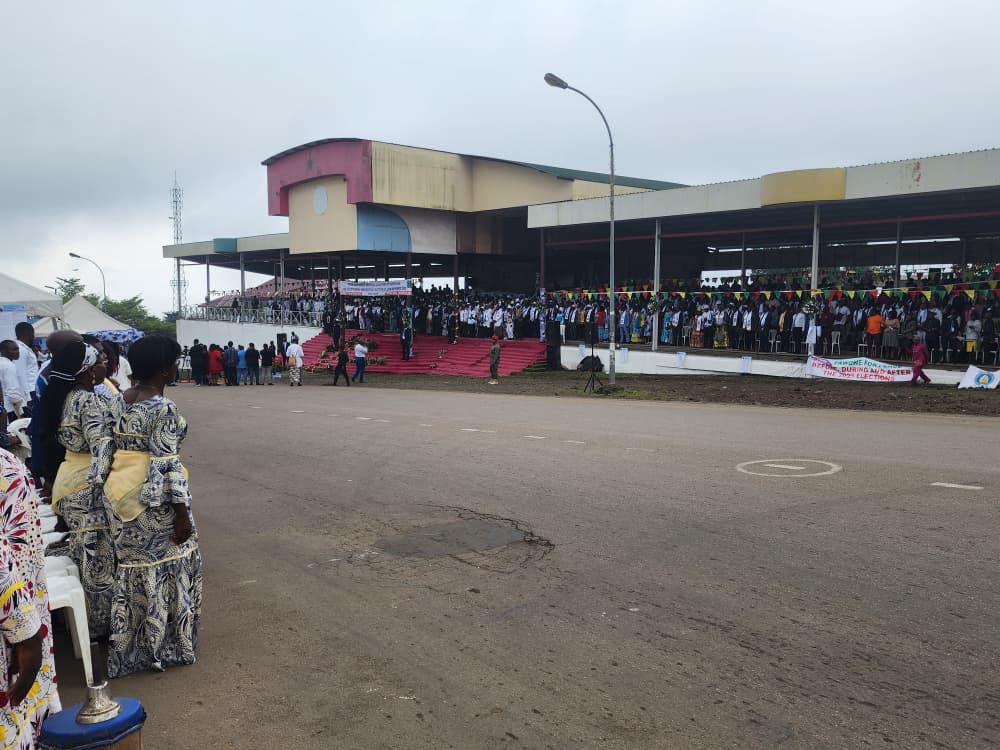
In a charged atmosphere in Buea on September 27th, Prime Minister Chief Dr. Joseph Dion Ngute delivered a resounding endorsement of President Paul Biya’s candidacy, framing the upcoming October 12th presidential election as a pivotal moment for the Southwest Region. The regional launch of the Cameroon People’s Democratic Movement (CPDM) campaign was not just political theatre, it was a strategic call to action.
Dion Ngute’s message was clear: the region’s continued development hinges on Biya’s re-election. Citing landmark projects such as the Kumba Gas Plant and the reconstruction of SONARA, the Prime Minister argued that these achievements are direct results of Biya’s commitment to the Southwest. “Politics is a game of interest,” he declared, “and President Biya has the interest of the Southwest Region at heart.”
The PM dismissed rumours of SONARA’s relocation, pointing to ongoing reconstruction efforts as proof of its permanence. He also spotlighted future projects, including the Limbe Deep Seaport, Bekoko-Idenau road, and Tiko Airport, as part of a broader development pipeline that, he warned, could be jeopardized under a different administration.
The campaign narrative, as shaped by Dion Ngute and echoed by CPDM elites, positions Biya not just as a candidate but as a guarantor of regional stability and privilege. Senator Nfor Tabetando urged supporters to honour past motions of support with decisive action, warning against complacency despite the region’s CPDM stronghold status. “No two elections are the same,” he cautioned.
This framing, where voting becomes a form of self-preservation, raises critical questions about the intersection of development and political loyalty. Is regional progress contingent on partisan alignment? And what does this mean for democratic plurality?
Professor Elvis Ngole Ngole, Director of the CPDM Academy, outlined a campaign strategy that leans heavily on social media to engage young voters. The grassroots approach, including door-to-door outreach, aims to reinforce Biya’s pledge that the next seven years will prioritize youth and women.
This digital and demographic pivot signals an awareness of shifting voter dynamics. Yet, it also invites scrutiny: will promises translate into policy? And how will youth and women measure progress beyond campaign rhetoric?
Dion Ngute’s analogy, comparing President Biya to a cocoa tree that should not be cut down due to age, was met with enthusiastic approval. But beneath the metaphor lies a deeper tension: the balance between legacy and renewal. At 92, Biya’s longevity in office is both a symbol of continuity and a point of contention.
For the Southwest Region, the stakes are undeniably high. But as campaign messages saturate the airwaves and doorsteps, voters must weigh promises against performance, and loyalty against long-term vision.